Objective system
The problem
When developing an innovative product, you regularly have to change course. It may be a change in company strategy, a pivot, or simply a change of tool or method within a team. Either way, information often struggles to flow through the whole company, and the consequences are sometimes discovered very late.
More generally, making sure every member of the company knows the strategy and understands how their work fits into it can be difficult. Yet making sure everyone moves in the same direction is essential to reach your objectives quickly.
A system for managing company, team and individual objectives is therefore essential to go far, and fast.
SMART objectives
Many objective management systems exist. Most agree that a good objective is SMART:
- Specific. The objective must match well-defined work that the person responsible for it understands well.
- Measurable. The objective must include one or more metrics to measure progress objectively.
- Achievable (or Ambitious, depending on company culture). The objective must be a motivating challenge, with a difficulty sized to the available workforce.
- Relevant. The objective must be a milestone that makes sense within the company’s vision and strategy.
- Time-bound. The objective must have a deadline.
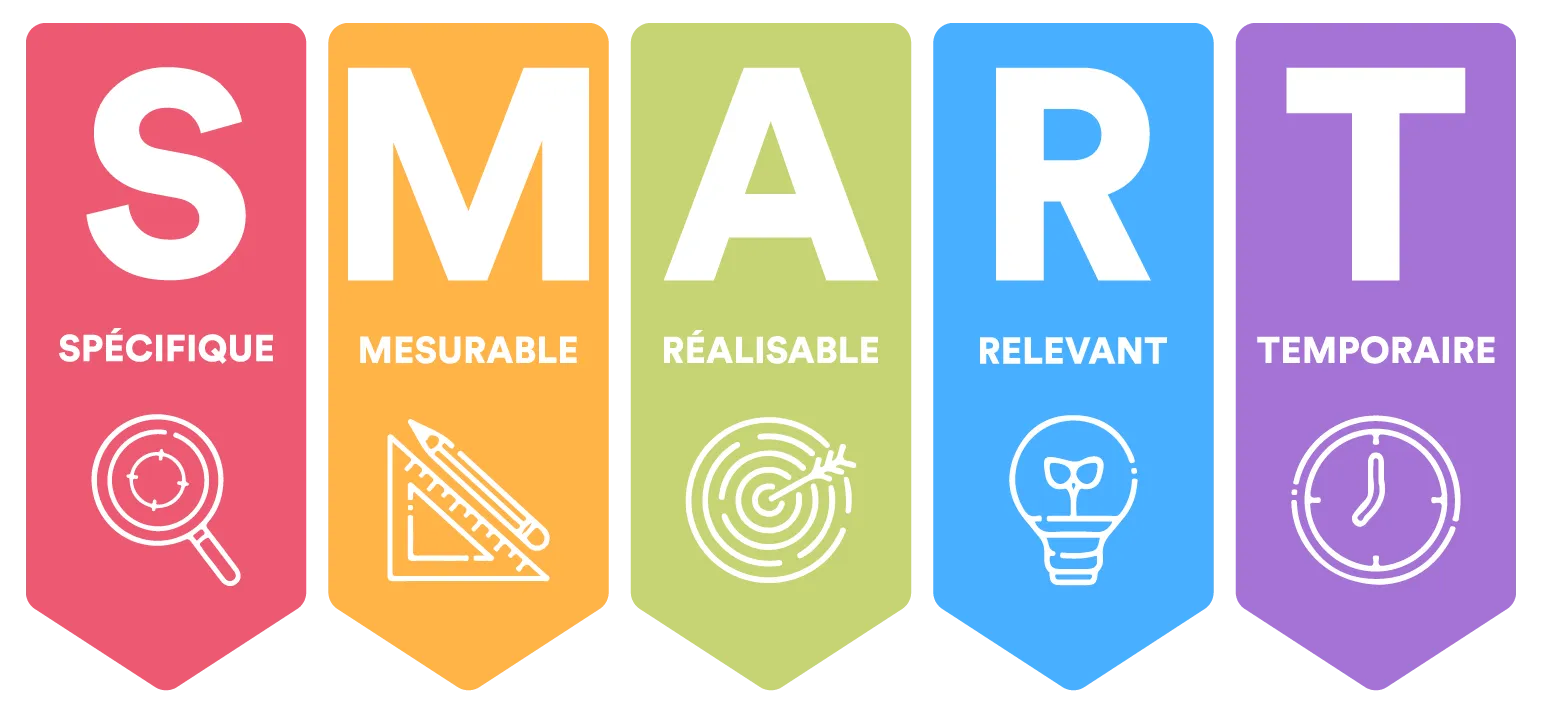
Without a predefined framework, a company can quickly get lost and discouraged by the effort of checking every criterion each time an objective is set. The solution I recommend is to use OKRs.
The OKR system
OKRs (Objectives and Key Results) are a system invented at Intel and popularized by Google. The system is explained in detail in John Doerr’s book Measure What Matters.
The principle is that each level of the hierarchy (company, department, team, individual) sets its own objectives for the coming period. Each objective comes with Key Results that make it measurable. As work progresses during the period, individuals and managers report how the KRs evolve.
A period is a regular length of time that can differ from one level to another. Typically, company objectives are annual. Departments set quarterly objectives, which act as milestones towards the company’s annual objectives. Teams can have quarterly or monthly objectives, depending on the organization and how responsive they need to be. Individuals preferably have monthly objectives.
The level above (level N+1) reviews the objectives set at level N, challenges them, and identifies any gaps that would prevent level N+1 from reaching its own objectives. If there is a problem, the levels discuss together to find solutions that let each of them reach its objectives. If that doesn’t seem possible, there is a problem with the strategy: it must be escalated up the hierarchy until a level can find a solution, or up to management to change the strategy.
The superpowers
The OKR system has many advantages. It provides a framework that is easy to set up and naturally leads to SMART objectives.
But above all, the OKR system lets superpowers that every leader dreams of emerge in the company culture:
- Focus teams on what contributes to the company strategy. The formal link between company strategy and individual objectives ensures the important work gets done.
- Align teams with great responsiveness. When priorities change at one level, the levels below naturally adapt their objectives.
- Track progress. Tracking lets you react quickly when the curve goes the wrong way.
- Surpass yourselves. When a whole organization pushes together in the same direction, multiplier effects kick in and can move mountains.

The tools
OKRs should not be confused with tasks. Many task-tracking tools exist to optimize the execution of low-level tasks, but they are generally not suited to steering the development of an innovative product. Although they can complement OKRs, I don’t recommend trying to manage OKRs with that kind of tool.
You can start with a spreadsheet for your first OKR cycles, to learn the method. It can work very well for one or two small teams, but it quickly reaches its limits as the number of people grows.
To get started, you can download my OKR tracker template (Excel file) or open it in Google Sheets (File > Make a copy to use it).
Perdoo is a more powerful tool that enables true company-wide steering by linking OKRs to the company strategy.
Need help?
Not everything can be said in a web page. Besides, every company or organization has its own specifics, which mean the method must be adapted when it is put in place. I can support you in adopting and applying the method so that it meets your needs: discover my offer.